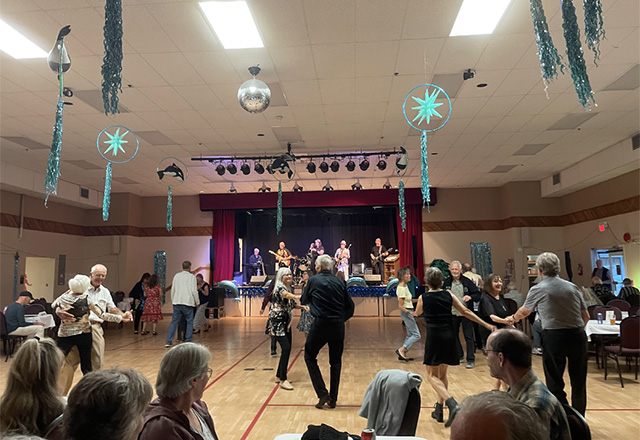
 The Sechelt Seniors Activity Centre hosted a lively and informative presentation on May 21st titled “An Upbeat Look at the Dangers and Joys of Artificial Intelligence” presented by former SSAC President, Richard Ward Ph.D. Admission to the event was by donation in support of the SSAC Affordable Lunch Program.
The two-hour session explored both the exciting possibilities and the growing risks associated with Artificial Intelligence (AI), particularly for seniors. Combining humour, practical demonstrations, and real-world examples, the presentation aimed to remove some of the mystery surrounding AI while instructing attendees about how to protect themselves from emerging scams.
Richard began by explaining that Artificial Intelligence is basically complex human-written computer programs running on enormous supercomputer systems capable of processing vast amounts of information at incredible speeds.
A typical laptop has one dual-core central processing unit (CPU) whereas world-class AI supercomputers often have over 1 million CPU cores. They are not one computer, but multiple computers networked together occupying entire buildings. A typical laptop processing speed might be 3.0 GHz, meaning that it can process approximately 3 billion calculation cycles every second. However, an AI Supercomputer can process over 1 quintillion calculations per second (1,000,000,000,000,000,000). In addition to processing speed, the available memory for storage of information (RAM – Random Access Memory) during calculations is important. A typical laptop might have 8 to 32 Gigabytes of RAM. In comparison large-scale supercomputers can have over 9 petabytes (9 million gigabytes) of RAM.
It was explained that OPEN AI is both a term describing a philosophy and the name of a company. Open AI essentially refers to making AI freely accessible by having programs on the World Wide Web running to allow anyone to query the AI supercomputers they serve. The Company AI is a business. One of its products is ChatGPT which can be used in a limited form for free, but by monthly subscription to allow use of its more sophisticated functions.
The presentation then turned to one of the most important topics for seniors: AI-assisted scams. Attendees learned how scammers are now using AI to create highly convincing fake emails, text messages, voice clones, photographs, and videos. Examples included fake “grandchild emergency” phone calls, fraudulent bank messages, romance scams, and realistic “deepfake” videos designed to deceive viewers.
Practical safety advice formed a major part of the afternoon. Participants were encouraged to:
- Never click on unexpected links in emails or
text messages - Call companies or family members back directly using trusted phone numbers
- Use strong passwords and two-factor authentication
- Be cautious about online relationships
- Avoid acting quickly under pressure or panic
- One particularly popular section of the presentation demonstrated the creative side of AI, using both Google AI mode and Chatgpt (which can be accessed at Chatgpt.com).
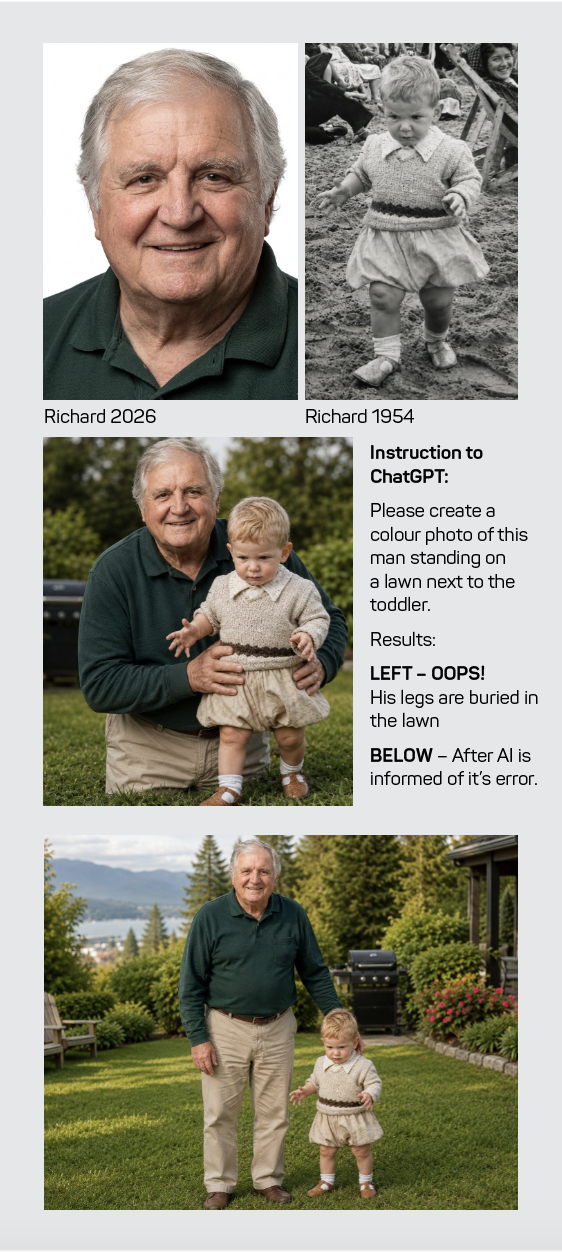
Richard showed how AI can assist with writing, editing, generating artwork, and creating new images from simple instructions. Audience members enjoyed seeing examples of AI-generated graphics and photographs, including Richard inserting a svelte image of himself into an England Football team photograph standing next to the team as if he were their manager. Another colour “photograph” put Richard standing on a lawn next to his 15-month-old self, as depicted in a 1955 photograph. The hilarious first attempt with ChatGPT had Richard with his legs buried thigh deep in the lawn. An example of how AI can make drastic mistakes. Throughout the session, Richard emphasized that while AI can be extremely useful and entertaining, users should always remain cautious. Information generated by AI may sometimes be incorrect or out of date, and personal or sensitive information should never be submitted into public AI systems.
The presentation concluded with an interactive “Play Time with AI” session where attendees were able to ask questions and explore some of AI’s capabilities firsthand. A lovely purple birthday card was created, based on the participant asking for wine, a kayak, unicorn and a bicycle to be inserted in it.
The afternoon provided members with a balanced, practical, and accessible introduction to one of the fastest-changing technologies in the world today and was aimed at helping seniors become both more informed and better protected in the digital age.